
-
TAKE ACTION
-
NEWS AND EVENTS
-
ABOUT US
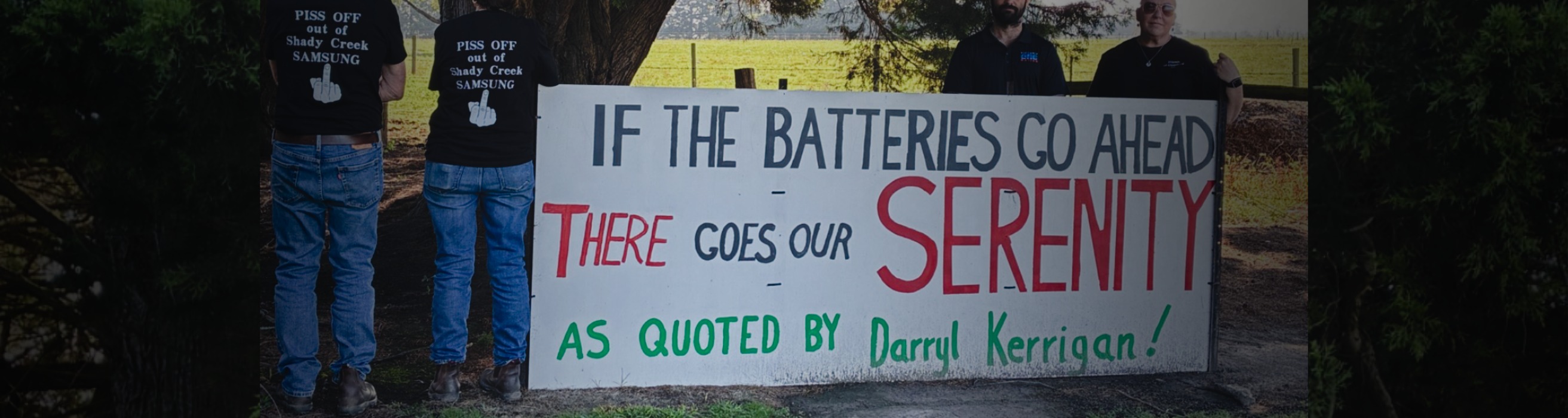
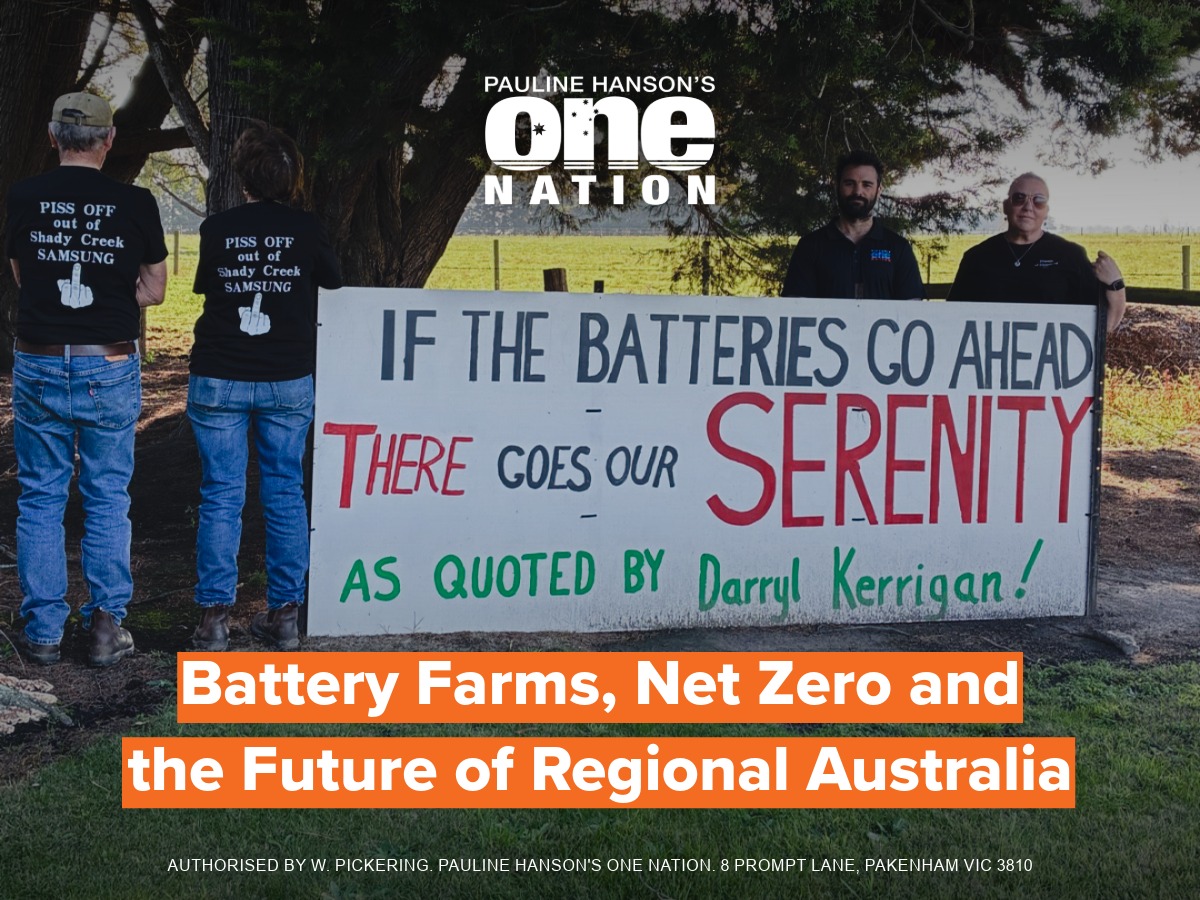
Battery Farms, Net Zero and the Future of Regional Australia
Across regional Victoria, farmers and local communities are increasingly being asked to shoulder the burden of Australia’s aggressive “net zero” transition.
Battery Energy Storage Systems (BESS), massive transmission lines, industrial solar developments and wind turbine projects are no longer isolated proposals- they are becoming the defining feature of many rural landscapes.
And the question many regional Australians are now asking is simple:
Who is this transition actually benefiting?
For generations, farming land has been protected because food production matters. Productive agricultural land is not just dirt- it is the backbone of regional economies, family livelihoods and Australia’s food security.
Yet under the banner of “renewables,” prime farming land is increasingly being transformed into industrial energy zones.
Communities are told these projects are necessary to save the environment, reduce emissions and secure cheaper power. But everyday Australians are seeing the opposite.
Power prices continue to rise. Grid instability continues to increase. Manufacturing and industry continue to struggle under growing energy costs. Farmers face uncertainty over land use, fire risks, visual impacts and the long-term consequences of large-scale battery infrastructure being embedded throughout rural areas.
Many people feel there has been little genuine consultation- only pressure to comply with a political agenda already decided in Melbourne and Canberra.
The uncomfortable reality is that net zero ideology has become untouchable in modern politics. Major parties largely debate the speed of the transition, not whether the path itself is economically sustainable.
But there is another argument.
Reliable baseload power built modern Australia. Coal-fired generation delivered affordable electricity that allowed manufacturing, farming, industry and households to thrive for decades.
That is why High Efficiency, Low Emissions (HELE) coal-fired power stations continue to be discussed globally as a more practical alternative to rapid renewable overhauls. HELE technology is designed to reduce emissions compared to older coal plants while maintaining the reliability required to support industry and stable electricity grids.
Critics dismiss coal entirely. But many Australians are beginning to question whether dismantling reliable baseload power before viable alternatives exist has placed ideology ahead of practicality.
Regional communities should not be treated as sacrifice zones for policies designed by inner-city political and corporate interests.
Farmers deserve a voice.
Communities deserve proper consultation.
And Australians deserve affordable, reliable energy.
One Nation is the only party to openly and strongly oppose Net Zero.
Only One Nation is fully committed to exit the Paris Agreement and to incentivise coal-fired baseload generation, including HELE technology.
This conversation is no longer just about (debatable) emissions targets. It is about cost of living, national energy security, food production, regional identity and the future of rural Australia itself.
Do you like this page?